As the calendar advances toward December, families and educational teams have a unique opportunity: mid‑year reflection. For children receiving special education and behavioral support, November is an ideal time to reassess Individualized Education Program (IEP) goals. A thoughtful check‑in now helps ensure progress remains meaningful and aligned with each child’s evolving needs.
The Value of a November Reassessment
Reassessing IEP goals in November offers several key advantages:
- Early detection of mismatches: If a goal is too easy or too challenging, adjustments can be made before the current plan loses momentum.
- Responsive to growth: Children grow and change—even within a school year. A goal set months ago may no longer be optimal.
- Time for planning: Adjusting now gives the IEP team enough time to prepare changes, submit amendments, or revise the plan before formal reviews in spring.
- Better alignment with behavioral and language progress: Especially for children receiving Applied Behavior Analysis (ABA) or verbal behavior interventions, reassessment ensures that supports continue to build toward independence and effective communication.
Signs It’s Time to Adjust an IEP Goal
Here are some indicators that a goal might need tweaking:
- Stagnant progress: If data show little to no improvement over multiple review periods, the goal may be too ambitious or the support strategies may need revisiting.
- Goal already mastered: If a child is consistently exceeding the goal, it may be time to step up the expectation to maintain growth.
- Behavioral interference: If a student’s behavior is preventing them from engaging in goal‑directed learning, supporting behavioral goals first might be necessary.
- Transition in environments: Midyear class changes, new support staff, or schedule shifts can change the context around goal attainment.
How to Conduct an Effective November Check‑In
To make your reassessment productive and actionable, follow these steps:
- Gather data: Collect progress monitoring, session notes, behavior logs, and observation reports from all involved parties (teachers, therapists, parents).
- Convene the IEP team: Bring together general education teachers, special educators, behavior analysts, speech/language pathologists, caregivers — anyone who contributes to goal outcomes.
- Review goal relevance: Ask: Is this goal still meaningful? Does the child show readiness for more advanced objectives?
- Examine barriers: Identify roadblocks such as lack of opportunities, support inconsistencies, or overlapping demands in the school day.
- Propose modifications: Adjust the goal (increase or moderate expectations), refine strategies, or add supports (e.g. prompting, scaffolding, reinforcement changes).
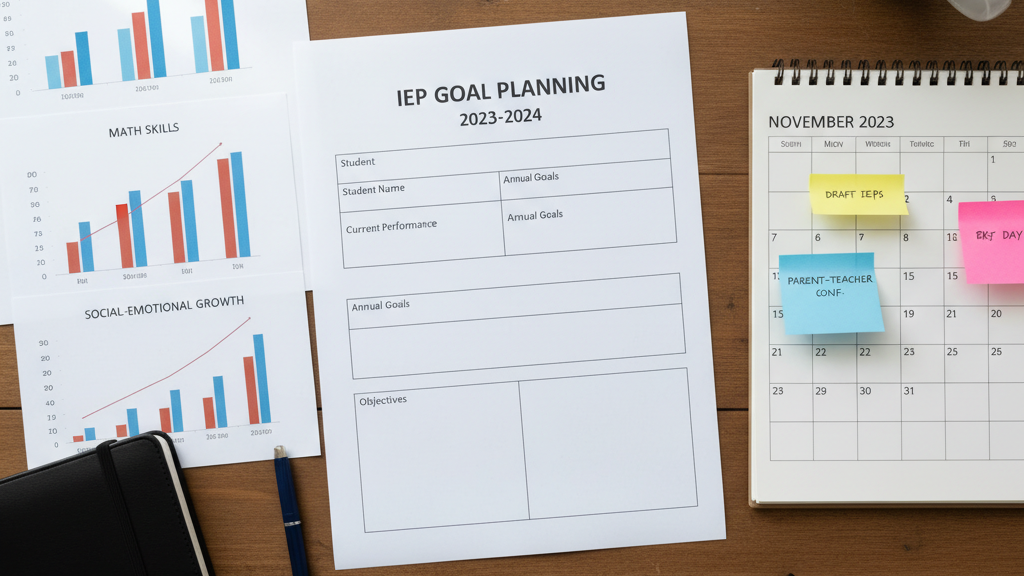
- Document amendments: Use interim goal amendments or addendums if allowed under state or district policies, and circulate updated goal drafts to all team members for feedback.
- Set a mini‑review date: Schedule a follow‑up check (e.g. mid‑January) to evaluate whether the tweaks are working.
Special Considerations for ABA / Verbal Behavior Supports
Given our focus at VBA on language development through ABA and verbal behavior strategies, here are some additional suggestions:
- Ensure goals remain functional: Prioritize communication goals that directly impact daily independence, social interaction, or frustration reduction.
- Balance scaffolded support and fading: If a learner is overly prompted, it may limit independent responding — gradually fading prompts or modifying reinforcement schedules may help.
- Address generalization: Check whether the child is applying the skill across settings (e.g. classroom, home, community). If not, embed generalization into the updated goal.
- Coordinate across team members: Make sure that behavior, language, and academic goals support rather than conflict with each other.
Benefits as You Head Into the New Year
A November reassessment sets a stronger foundation for the end of the school year. Some of the immediate benefits:
- Greater momentum: Optimally calibrated goals keep children motivated and engaged.
- Smoother spring IEP planning: By the time annual reviews approach, most adjustments are already in motion.
- Stronger team communication: Frequent, data‑driven check‑ins strengthen collaboration between caregivers and professionals.
- Better resource alignment: Whether through ABA support, speech therapy, or classroom accommodations, resources can be reallocated more effectively when goals are current.
Tips for Caregivers During the November Reassessment
As a caregiver, your input is invaluable. Here’s how to prepare:
- Track progress between formal reviews: Collect examples, videos, or anecdotal notes to illustrate progress or challenges.
- Be honest about supports at home: Share whether strategies used in school translate to home and where additional consistency is needed.
- Ask clarifying questions: Request data trends, baseline comparisons, and rationale for any proposed change.
- Stay open to change: Goal adjustments don’t mean failure—they reflect dynamic growth and responsive support.
Next Steps: From Reassessment to Implementation
Once the IEP team agrees on adjustments:
- Create a short, written amendment or goal addendum reflecting the changes.
- Communicate the updated goals and strategies clearly to every implementer: teachers, therapists, paraprofessionals, and family members.
- Train or review methods with staff who will carry out the revised plan.
- Ensure consistency in data collection — all parties should use the same formats and timeframes.
- Evaluate impact after a preset interval (e.g. 6–8 weeks). If progress still lags, revisit the IEP team and repeat the cycle.
Conclusion
November provides valuable runway before the end of the calendar year—and more importantly, before spring IEP reviews become top of mind. By intentionally checking and refining goals now, teams can ensure that objectives stay relevant, achievable, and aligned with a child’s growth trajectory. It’s an opportunity to catch mismatches early, maintain momentum, and strengthen collaboration.
If you’d like support with reassessing IEP goals, integrating ABA or language strategies, or preparing for an upcoming IEP meeting, Contact us. Our team at VBA is committed to guiding families and educational teams toward meaningful, effective goals that support independence through language development.